Reflect
Don't let fear steer the ship
On navigating pressure, difficult waters, and the choice to hold your course when the sea turns rough.
When my daughters were young one of our favourite books was a fun book called "Don't let the pigeon drive the bus!"
That line from Mo Willems' children's book has stayed with me more than I expected. The whole story turns on a simple instruction: do not let the persistent, emotional, manipulative voice take the wheel. The pigeon tries everything: pleading, bargaining, sulking, flattering, because it desperately wants control.
It reminds me of fear. Fear is an essential response to danger. The curious thing about fear is that it can short-circuit the brain and pull us into a more primal state. It floods the body with adrenaline and puts us on alert, ready for action. It can also distort perspective, making threats seem larger than they really are. When that happens, clear thinking becomes harder. Calm judgment can give way to reaction.
Perhaps that is why disciplined training matters so much. Sailors do not wait for the storm to decide how they will respond. They drill, rehearse and prepare so that when the sea turns rough, they are not relying on panic or improvisation alone. When the waves rise and visibility drops, training, habit and principle become the difference between chaos and control.
So what does that mean for life in the workplace? For me, it means this: fear should not define the narrative. When pressure rises, when uncertainty creeps in, when the situation becomes unclear, I do not want to be swept along by instinct alone. I want a set of principles, decisions and habits already in place, so that when I feel all at sea, I still know how to find my bearing.
Know what you are navigating
It may sound dramatic to speak of enemies, but in working life the real dangers are often less visible than we expect. They are the hidden currents, shifting tides and sudden squalls that throw us off course if we do not recognise them.
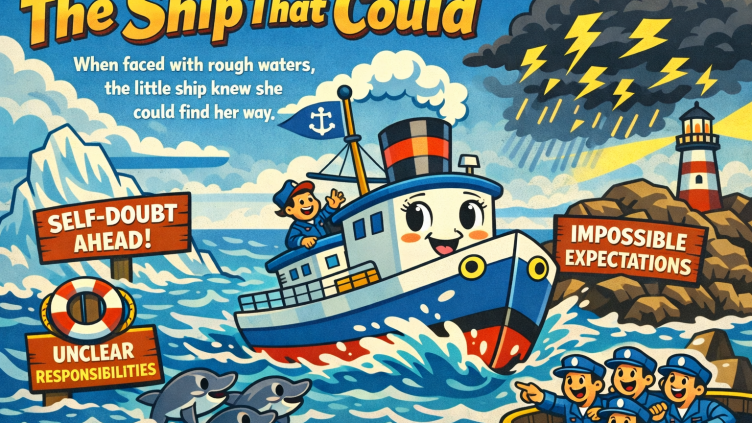
Self
Sometimes the roughest waters are internal. There are parts of my own character that are not yet steady enough to overcome some of my challenges. Fear can take the form of self-doubt, defensiveness, avoidance, or the need to prove too much. Before I am navigating external pressure, I am often first navigating my own reactions to it.
Unclear responsibilities
There have been many times when I have felt expected to be all things to all people. In those moments, fear of failure can push me into dangerous waters. I take on more than I have the capacity or capability to carry, and before long I am overwhelmed — not because I lack commitment, but because I have lost clarity.
Yet these situations can also be some of the best opportunities for growth, if they are handled well. When you are sailing in unfamiliar waters, say so. Let your team know when you are operating without a full chart. Acknowledge that mistakes may happen. Be honest about the parts of the role that do not come naturally. Ask for guidance. Build in accountability. Mentoring, escalation routes and transparent oversight are not signs of weakness; they are part of good seamanship.
Most importantly, create a culture where learning is not treated as failure. Growth is rarely neat. It often feels, at least for a while, like being all at sea.
Difficult stakeholders
Difficult stakeholders are part of every environment. There will always be people who challenge, resist, frustrate or unsettle us. We can spend our energy resenting them, or we can try to understand the waters they are sailing through.
That does not mean excusing poor behaviour. It means looking for what lies beneath it. People usually have reasons for how they respond, even if those reasons are not immediately visible. Pressure, past disappointments, conflicting incentives, or simple exhaustion can all shape the tone someone brings into the room.
Leadership in this context means helping people find a shared heading. It means establishing common ground and forming a mutual understanding of what good looks like. It means learning to work alongside people who may be sharp-edged, while remembering that we are all capable of being someone else's difficult colleague.
Very few people begin the day intending to do a bad job.
Seemingly immovable barriers
Some barriers feel too large to overcome alone. That is why crews matter. At sea, no captain succeeds without a crew, and no crew thrives without trust. Strength comes not from individual heroics, but from coordinated effort. In working life, too, there are challenges that feel impossible when carried alone but become manageable when shared across a capable team.
Leadership here looks like confidence in the crew. It means believing that together you can navigate rough water, even if no one person can master it alone.
Impossible expectations
Impossible expectations often arise from inexperience, poor communication, optimism unmoored from reality, or the quiet habit of saying yes too quickly. Fear makes those expectations feel even heavier. It convinces us that we must somehow meet every demand, absorb every pressure and deliver every outcome flawlessly, no matter how unrealistic the conditions.
Leadership in these moments means naming reality early. Sometimes it also means refusing to sail into a storm simply because someone on shore insists the weather is fine. Saying no is not always negativity. Often it is stewardship.
When expectations become impossible, fear says: keep quiet, work harder, and hope nobody notices the strain. Wisdom says: surface the issue, involve the crew, and adjust course before damage is done.
One path leads to burnout. The other leads to trust.
Hold your course
Fear will always be part of life. The aim is not to eliminate it, but to stop it from taking the helm.
Preparation matters. Character matters. Crews matter. Self-awareness matters. Courage is not the absence of fear, but the refusal to let fear steer.
In the workplace, as on the sea, conditions change quickly. Waters that looked calm in the morning can turn by afternoon. The challenge is not whether uncertainty will come. It will. The challenge is whether, when we find ourselves all at sea, we can still hold our course.
That is the kind of person I want to become: someone who can feel fear, acknowledge it, and still choose clarity, honesty, empathy and disciplined action. Not someone untouched by the storm, but someone who has learned how to navigate through it.
What about you? When the pressure hits and the waters get rough, what helps you hold your course?