Reflect
Human Architecture (Foundations)
Most architecture thinking ignores the human kind. On community as engineered infrastructure, the cost of disconnection, and why belonging doesn't just happen.
Most of my day is spent thinking about how people, processes, and systems integrate. I look for data flows and single points of failure. But lately, I've been looking at a different kind of architecture: the human one.
A recent UCL study found that over half of people in the UK feel disconnected. In architectural terms, that's not a glitch; it's a foundational collapse.
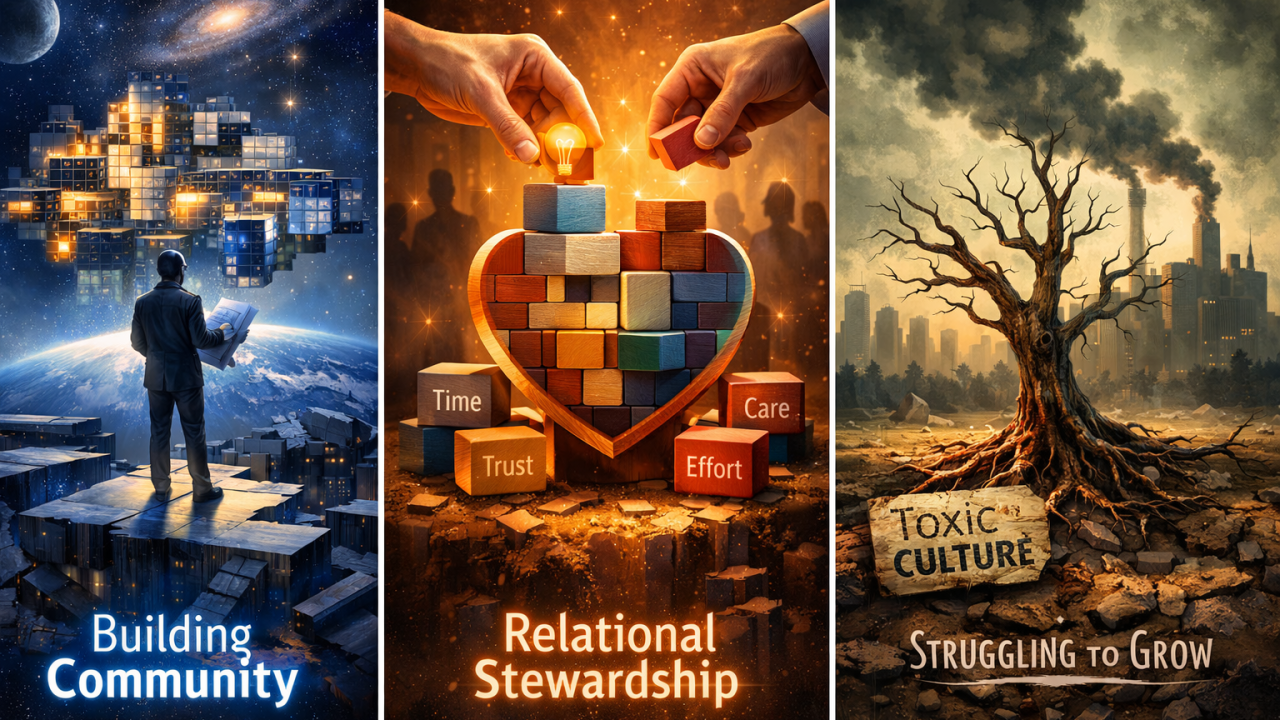
We often treat "community" as a byproduct of a nice office or a Slack channel. But as an EA, I know that connectivity doesn't just happen — it's engineered. If we don't intentionally build the infrastructure for belonging, the system defaults to isolation.
By community, I don't mean social activity or forced cohesion — I mean an environment where people feel safe enough to commit to each other, to shared principles, and to a future that extends beyond themselves.
When people say, "It's just a job," they aren't describing their workload; they are describing a defence mechanism. They are protecting themselves from a system that doesn't feel safe enough to support a real commitment.
Organisations pay for this in subtle but serious ways:
- Higher attrition
- Lower discretionary effort
- Brittle execution
Community isn't "soft culture." It's the infrastructure for trust, resilience, and long-term performance.
If community doesn't just happen — if it has to be built — what does the construction actually cost? Part two looks at the high price of Relational Stewardship.
Have you noticed "It's just a job" becoming the default setting in your sphere? Is it a symptom of a systemic disconnect?