Focus
The Ocean Ecosystem: A Post-Transformation Paradigm for AI
Finding the right metaphor for AI-augmented work has been harder than it should be. The ocean is it. Not for the poetry, but for the structure. Here are the five elements that determine whether your ecosystem thrives.
I have been looking for the right metaphor for a while. Factories, pipelines, digital highways. The ones we tend to reach for describe work as the movement of things. That framing was built for the industrial era. It is the wrong shape for what AI is making possible now.
The ocean kept coming back. Not for the poetry, but for the structural accuracy. An ocean is alive in a way no factory ever was. Organisms respond to local conditions in real time. Schools of fish coordinate without central command. Currents carry nutrients across vast distances with no logistics plan. The chemistry of the water governs what can and cannot survive. The whole thing runs continuously, adapts constantly, and has no project manager.
That is what AI-augmented work is becoming. The organisations getting this right are not running bigger transformation programmes. They are building ecosystems: environments where adaptation is continuous, where learning compounds across individuals and teams, and where the spirit is closer to agile at its best. Fail fast. Evolve faster. Make course correction a built-in feature, not an admission of failure.
What I have found, across the programmes that actually worked, is that this ecosystem has five distinct elements. All five matter. When one is missing, the system compensates for a while and then collapses. Understanding all five is the difference between a transformation programme and an adaptive organisation.
The Five Dimensions of the Ecosystem
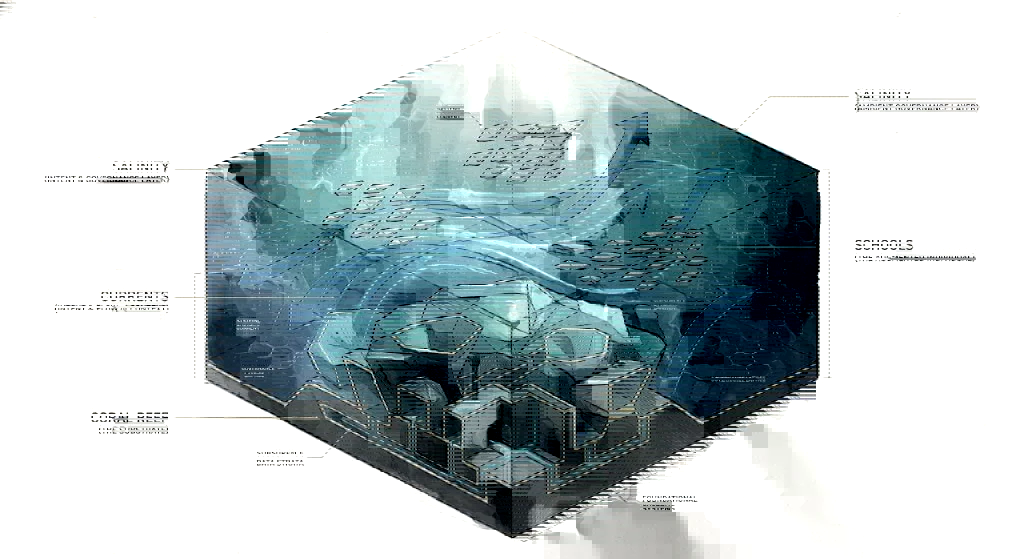
1. The Reef (Infrastructure)
Your core data architecture, knowledge management, and enterprise platforms are the coral reef. They do not move much. They are the substrate that provides structure and continuous generation.
When the reef bleaches (outdated pipelines, toxic technical debt, data that nobody trusts), the ecosystem does not slowly degrade. It collapses. Programmes shelve. Talent leaves. The window for competitive advantage closes.
Most organisations know they need a healthy reef. What they underestimate is that the reef is the substrate for life, not life itself.
2. The Schools (The Augmented Workforce)
Individuals and small groups, operating in partnership with AI, are schools of fish.
Unlike biological schools, these fish carry their own intent. They move in tight formation and change direction instantly in response to real-time signals, coordinated without centralised command. One analyst, with an array of AI tools configured to their context, can cover the ground of three or four people coordinating across two teams.
When the reef and current are in place, the system is magic; when they are not, the exact same setup just produces faster nonsense. In practice, this is one person doing the work of many, not by working harder, but because the cognitive load is shared with the AI collaborators, the reef, and the current, rather than sitting inside a single human head. What the AI cannot carry is what the fish bring themselves: their judgment, their domain knowledge, and their sense of what the work is actually for. The technology amplifies that. It cannot replace it.
3. The Shoals (The Coordinated Teams)
A single school of fish can cover surprising ground. A shoal is multiple schools moving in formation. Together, they can reshape the entire water column.
In an AI-enabled organisation, shoals are the cross-functional pods, squads, and communities of practice where individual practitioners, each already operating with AI, begin to coordinate their intelligence. The insight one analyst surfaces flows to the team. The prompt one practitioner refines becomes a shared asset. The output quality compounds across the group rather than staying locked inside one person's workflow.
This is where individual productivity becomes organisational capability. It does not require a formal programme. It requires the conditions for sharing: common memory, agreed norms, and enough trust that one person's AI-assisted insight does not threaten another's standing.
The failure mode is fragmentation. When AI adoption is individual and invisible, each person running their own tools in their own context with no shared practice, the fish are spread across the water. The output multiplies. The learning does not. Three analysts doing the same AI-assisted task three different ways are producing a fraction of the value they would produce if they moved as one.
The shoal is not a committee. It is the minimal unit of collective intelligence. It emerges when schools share what works, and choose to move together. In a world where AI capability evolves fast, the schools that move together will compound continuously. The ones that swim alone will fall behind. Shoals are not optional coordination. They are the survival mechanism.
4. The Current (Context & Intent)
The secret ingredient is not a component. It is the current.
In the ocean, currents keep the ecosystem alive, directing the schools and carrying nutrients to the reef. In an AI-enabled organisation, the equivalent is context and strategic intent: real-time operational truth, flowing directly to the people who need it, tied to a clear purpose that is universally understood.
One programme I worked on had clean, trusted data within six months and a governance committee still meeting quarterly while that data refreshed weekly. Nobody had built the forum where insight could become decision. The information was moving, but the decision pathways were frozen. When people are in the flow of the current, they and their AI collaborators act with accuracy and confidence. Without it, the fish just swim in circles.
5. The Salinity (Ambient Governance)
Governance, in this model, is not a wall.
Checkpoint governance is built for the audit moment, not the decision moment. It generates the minimum compliance necessary to pass, and no more.
Governance in a healthy ocean is salinity. It is the chemical composition of the water itself. It is ambient, built directly into the data layer, into the AI guardrails, and into the native paths where information flows and decisions are logged. Psychological safety is part of this salinity: the cultural chemistry that makes it safe to surface a problem before it becomes a crisis.
You cannot swim in the ocean without obeying its laws, not because someone is watching, but because the environment itself enforces its own chemistry. That is what mature AI governance looks like. Not a checkpoint, but a condition of the water.
Salinity governs the water. What governs the fish themselves — their identity, their sense of purpose, their understanding of what this organisation stands for — is something the water alone cannot supply. That is a deeper layer, and it is where the next risk lives.
The checkpoint model fails the moment the team doubles; the ambient model degrades gracefully. It still produces the audit trail, the regulator's evidence and the board's assurance, because ambient does not mean invisible. It means compliance is integral rather than supervisory. It takes real investment to build into the data layer, the observability stack, and the culture, but it is the only governance that holds when the team scales overnight.
The Realities of Scale and Accountability
Reef, schools, shoals, current, salinity. All five scale. They hold whether you are managing a single business unit or a multi-entity group.
However, the metaphor highlights a critical human truth: fish do not always swim, even when the conditions are perfect. Biologically, this is barotrauma. Hauled to the surface too fast and dropped back down too many times, fish become structurally bruised. They need time to acclimate to the pressure, not a stronger current.
Organisations that have survived twenty years of failed silver-bullet transformations carry the exact same damage. Long-serving teams suffer from deep change fatigue and learned helplessness. When a new initiative launches, the current can be flowing perfectly, yet the schools will remain completely still. This human readiness problem has a second layer: it is less about psychological safety and more about earned trust that this time is actually different. There is a third layer worth naming: pace. The AI tools that accelerate output also accelerate depletion. In an ecosystem running at the speed of possibility, the leaders who actively create space for recovery are not managing softly. They are managing sustainably.
Finally, we have to look honestly at the accountability question. The easy, siloed answer is to say the reef is the CDIO's responsibility, the schools and shoals belong to the COO, the current is the CEO's, and the salinity is the governance board's.
In practice, most CDIOs are held accountable for all five while the CEO owns none. That is precisely the dysfunction.
The honest framing is simple: the CEO must own the current, or the corporate strategy has no oxygen. The board must own the salinity, or governance is theatre. And the leaders closest to the schools and shoals need a different profile from the managers of the previous era. Their primary function is not oversight. It is the development, mentoring, and pacing of the people inside the schools. Name those owners, at that level. Until you do, this is a framework without teeth.
Which of the five is the one you have been quietly neglecting: reef, schools, shoals, current, or salinity?