Reflect
Shiny
On all things shiny and how they can burn. A personal essay on AI obsession, the seductive danger of irresistible tools, and why creation without renewal is depletion dressed up as productivity.
When I was young, I would regularly visit my dad's engineering business. He would work long hours, and I'm guessing my mum would encourage him to take me along to give herself some breathing room and perhaps help us form some sort of bond. The bonding never really worked, but I remember one visit clearly.
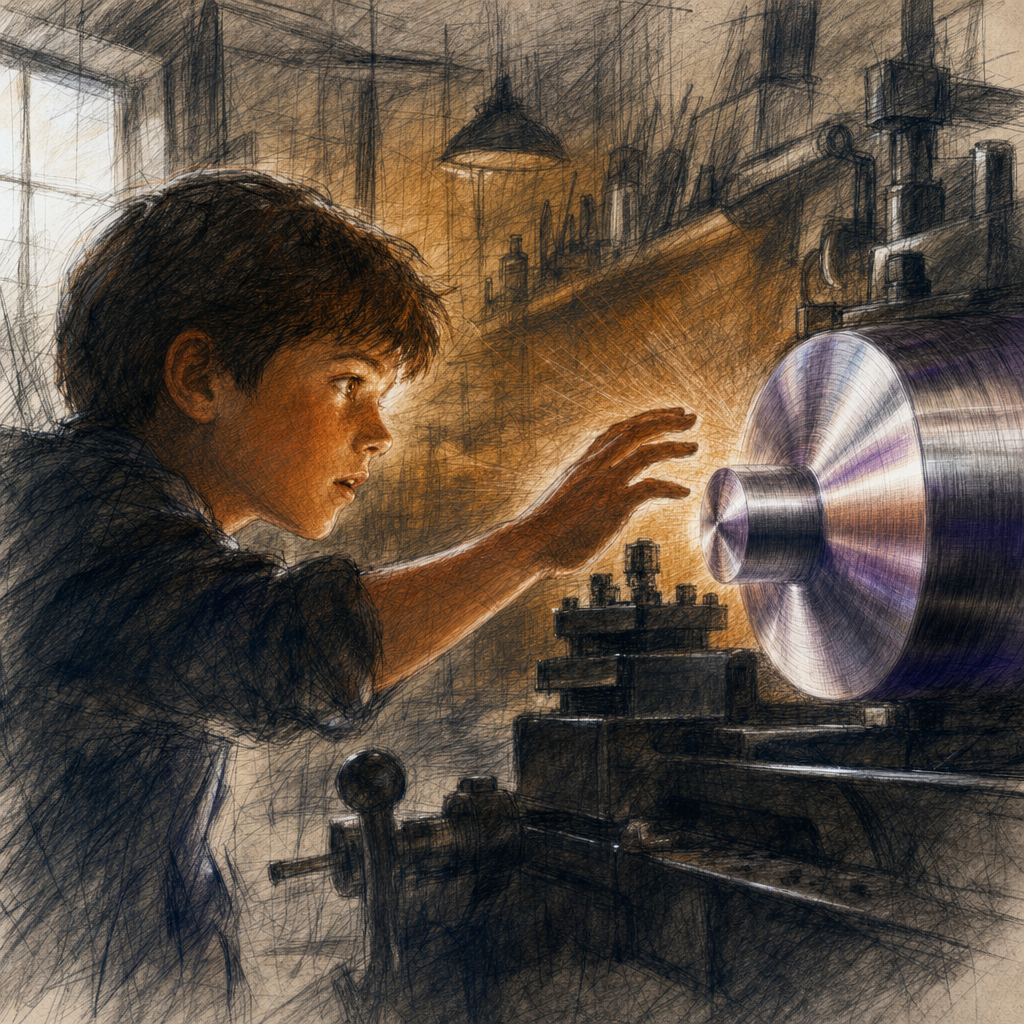
I was left alone in the engineering warehouse attached to the office. And there, in the middle of the space, I encountered the most beautiful thing I had ever seen: an impossibly iridescent, smooth chunk of steel, freshly lathed and gleaming under the warehouse lights. It had an almost magnetic effect on me. Being a Rust, perhaps that was only natural.
My dad had wandered off somewhere. I stood there alone, staring at it. I didn't think anything dangerous could be lurking in that beauty.
I was wrong.
Before I could stop myself, my hand was reaching out. My palm made contact with the surface and then I knew. I pulled my hand away as fast as I could, leaving a light layer of skin behind on the metal.
I don't remember the treatment that followed. But I have never forgotten the lesson: freshly lathed metal holds heat you cannot see.
Beauty is not a guarantee of safety.
I did not expect to need reminding of that at my age. Or that my PAI (my personal AI infrastructure) would fall into that same category.
Claude Code and my PAI system have that same quality. Irresistible. Shiny.
Over the past week, instead of reducing my cognitive load, it has started to increase it. My mind has begun to move with the pace of AI production itself. I find myself in moments of FOMO: thinking about ideas, ways to build new things, connections to make, systems to design. It has become almost obsessive.
After decades of struggling against limited capacity, I can suddenly see a way forward. A way to fulfil things I had long deferred. That feeling is powerful. And that is exactly what makes it all consuming.
My wife noticed before I did. She started commenting on how much time I was spending in front of the screen. Not just working, but building, tweaking, extending. The clearest signal came when I found myself nipping in and out during dinner to adjust some settings. That was the moment I recognised the pattern. I had touched the metal.
Oddly enough, it is my Claude Code Pro token limit that has kept me from spiralling. It forces me to stop when I have run out. The tool itself, inadvertently, built in the boundary I was not setting for myself.
So what does this mean for the rest of us?
It is not enough to have expanded capabilities with Personal AI by your side. You need to ensure you are living a balanced life alongside them. This has to be wired into how you partner with AI, not bolted on as an afterthought.
You have to put the tools down. Both physically and mentally. You have to build habits that enable you to be the best version of who you are, and those habits exist mostly away from the screen.
The answer is not complicated. But it does require intentionality.
- Connection is vital. We are relational beings. Isolation amplifies obsession.
- Move your body. Physical activity is the reset mechanism, not a nice-to-have. It is the brake.
- Protect space for reflection. Self-awareness is what keeps compulsive behaviour in check.
- Create something that is not AI. Music, cooking, a sketch, a conversation. Remind yourself you are the maker.
- Name your limits and keep them. Decide when the tools go away, then actually put them down.
Stephen Covey called this sharpening the saw. The principle is not new. What is new is that we now need it to protect us from our own tools.
Creation without renewal is depletion dressed up as productivity.
This piece was not intended as a commentary on The Hobbit. But I will take the parallel. Don't let PAI become your Precious: the one thing that consumes you, isolates you, and slowly narrows your world to the glow of a single screen. Sméagol didn't start out that way. Neither do we.
The goal is not to resist the tools. It is to remain the one holding them.
We are more than what we build. More than what we can produce before the tokens run out.
Some things look cold when they are burning. The wisdom is in knowing the difference before you reach out.